This topic is getting delayed time and again, but i have been blasted with demands to write about it since the previous post, both from friends who are moving to North America and from those stationed in North America considering the political climate. Keep in mind that this is an inherently negative topic, which is why i have been avoiding writing about it. But if you can take away the basics from it, it might just help you.
So here’s doing the best service that can be done.
Lets talk about the port of entry and what to do and what not to do in the quickest format .
Border Control officers are federal officers assigned at ports of entry of every country that you visit. Often they are not a part of the immigration regulation body of the government but are a part of the internal security service of the nation. This includes the department of Homeland security in the united states and the Department of public safety in Canada. These often do not include enforcement police like I.C.E or its Canadian synonym CBSA.
For the record, as long as you are not a citizen, you are subject to scrutiny by the Border control officer at the port of entry. This applies to Permanent residents, green card holders, students, business visitors , tourist visitors, asylum seekers, as long as you are not a citizen, it is on.
Having a visa does not mean automatic entry into a country. A visa is a document issued by the embassy or the consulate which authorizes the individual to walk up to a port of entry and seek permission to enter the country.
At the port of entry, a border control officer is responsible for the main decision to let the person in or not and is the main controller of the gate.
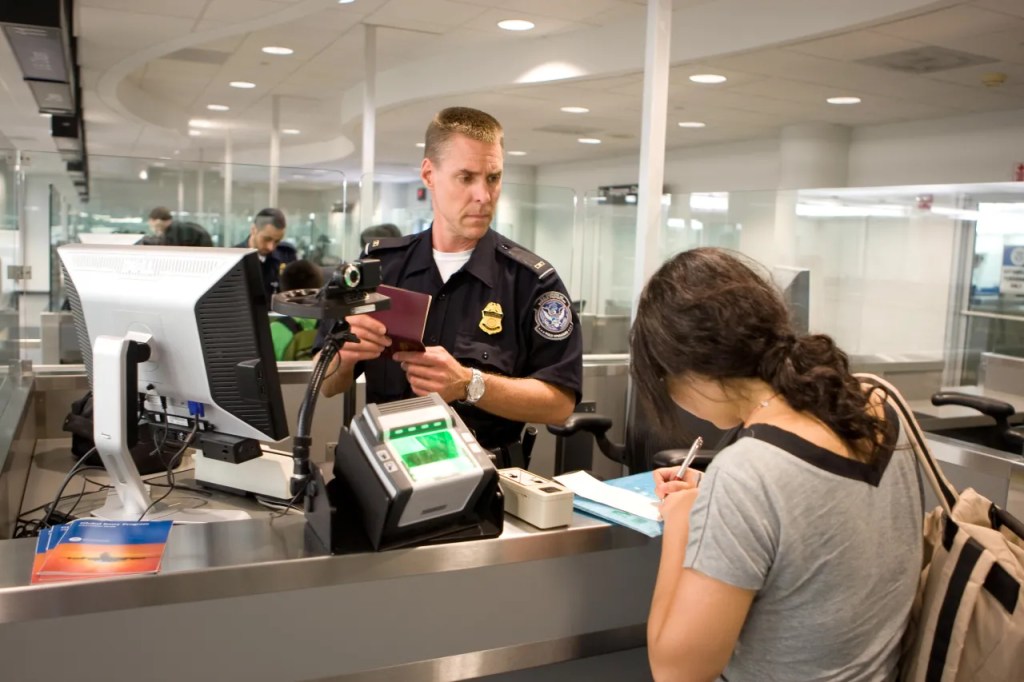
These 4-5 minute interviews as shown in the picture are not somethings to be taken lightly, the guy behind the counter has more authority than you would think he does. It is very important to be honest, nice, cooperative and forthcoming.
Country by country border control officers have their own characteristics.
I like to take the examples of national animals when talking about border control officers because it has at least some synonymity to the officers general behaviors and also to bring in some humor to this most universally dreaded post.

The German border control officers are synonymous in nature to its national animal the federal eagle. Rude, caustic, illogically annoyed that the foreigner does not speak the language, sarcastic, direct and perpetually always irritated…. Although debarments often do not happen, the right to passage will be strange and unpleasant, because why not?.

The American Border control officer is similar to the bald eagle. Keen eyed, skeptical, suspicious, direct questioning, investigative, will not believe your bullshit, highly likely to check your phones, very handsy with giving the second round of investigation orders where your luggage is checked thoroughly and items are flung out, including your social media and bank accounts. A Perpetual and constant annoyed expression due to the constantly changing immigration policies and the irrational political environment.

The Canadian Border control officer is like the beaver. Very pleasant to deal with, will ask you generic questions, can be very dual faced in intention and hard to read. luggage checks are not a practice as common as in the USA, however once you get to the point expect a full investigative process up to all your previous entries. Will build a dam if necessary, that means handsy with exclusion orders and debarment orders of up to 5 years. All this will be done while treating you compassionately. Even the debarment process can be ‘pleasant’ to the point of wierdness.
Exploring the difficult points now after the humor.
What can the border control officer do ?
The border control officers can do anything necessary as described within the regulations to achieve the objective of the statute for which it was put in place. This means making sure that there are no general inadmissibility issues of health concerns, criminality and unauthorized entries. Mostly all meassures are acceptable at the port of entry other than those protected by the international human rights to achieve the purpose. This means :
checking your luggage
checking your phone, text messages, social media,
checking your bank account, documents, and investigating your previous entries.
checking your health records and doctors information.
If you can think of it, it can be done. This includes second and third round of investigations which are usually reserved for human smugglers and drug peddlers who ingest pills of cocaine to pass immigration.
What makes the officer annoyed ?
In order of preference below
Never appear like you have plans to STAY. This is possibly the number 1 reason for debarment. The word ‘stay’ should not be part of your vocabulary. Infact, what you should say instead is something like this (repeat if necessary) ‘ i plan to stay for x months, and then i plan to go back to my country’.
For those wondering about the scope of ‘plans to stay’ – it goes further than one has a general understanding of.
For example: if you visit your children on a tourist visa, the officer should not think at the port of entry, that you are visiting with a consequent plan to move there in the foreseeable future. If you visit on a tourist visa, the officer should not think at the port of entry that you planned to eventually settle in the country through some activity. The far off possibility that entangles the purpose of the visit should not have anything to do with ‘settling in the country’. The purpose of the visit, should be the purpose of the visit as described in the visa and as presented to the officer. As a general rule, this is a major pet peeve of the BCO and lands people almost always into investigative round 2 where luggage checks occur and items are flung out, to make sure you are not visiting for the purpose of settling. It means, if you are a tourist in Canada or the USA, then tell the officer that you plan to visit tourist locations, and plan to go back to your settlement. However, if you tell the officer that you don’t have anybody else back home, and you are visiting your only daughter in Canada because you are out of work or retired, the officer will put two and two together and begin to wonder if you plan to go back at all despite your return plane tickets or if the purpose of your visit was to seek eventual settlement in the country. This is not a good sign. Often times this might appear like far fetched thought process, but officers are trained to think like that and imagine different scenarios.
Criminal inadmissibility: apart from the ones declared in the visa or not declared this is broader in scope than one thinks it is. The BCO will consider crimes that you are not even convicted of officially up to a span of 10 years. It means even if there is an allegation which did not result in a conviction it is subject to BCO investigation and dependent on the BCO’s discretion will lead to an outcome. Worse than this is attaining a criminal issue when within the country. Below is an example of how stringent this can be and how this can result in different scenarios.
- https://www.aljazeera.com/features/2025/3/27/columbia-let-me-down-how-indian-scholar-expelled-by-trump-fled-the-us. There was a story some time ago where Indian PhD candidate at Columbia was about to be detained by ICE due to some of her anti Israel protests when her visa was cancelled. Ranjani Srinivasan claimed that the protests were her right as part of being a student at Columbia and at the time of the protest she was just a passer by and was not directly involved in anything. However what most people dont realize is that the risks for international student protestors are not the same as those for citizens. The F1 visa comes with clear national security stipulates which are taken very seriously. Most people dont understand that the issue is not that Srinivasan engaged in protests, the issue was that during the protest, buildings were vandalized, windows were broken and Srinivasan was there when it happened. At times like these, police issues an automatic conviction to individuals present on site. Even though the conviction was dropped, it had to at least be declared to the consulate. In this case, Srinivasan incorrectly assumed that since there was no conviction which resulted, she failed to declare it to the consulate, resulting in a violation of the agreement of her visa and debarment of her visa. It means that temporary residents are on automatic high risk criteria. One might have the right to protest, but it is highly recommended that you dont protest. For one, you may even be part of a peaceful pride parade and windows might get broken by few happy drunkards, if the cops arrive and there is even a conviction that is dropped, you have a few chickens to take care of with no fault of your own. Hence the reason, stay away from protests, parades, drunkards who pick public fights, and anything to do with a conviction. The path for coming out of such a small thing can be long and ardous. You might have to reapply to the consulate after a debarment ends, explaining to them the circumstances, you might reapply on humanitarian and compassionate grounds or you might appeal in the federal court if you thought the BCO erred in his decision. Bottom line – not worth a fool who broke a window and not worth the protest either.
For one if you think immigration is stupid , then immigration uses a GCMS system in Canada and in the USA the class and tech systems. It means, there is a clear record of where the person was, if convicted or not convicted via biometrics including all officer notes included about what was seen heard and registered. Both countries exchange information with each other via CUSMA or formerly NAFTA agreements in place, for when someone who debars rules in one country absconds to another, the information is exchanged and appears magically to the BCO in another nation. If one applies for a FOIA or RTIA then one will be surprised to find massive notes for an entry.
The Third – not following the terms of the visa or a lack of compliance. This is another major pet peeve for the BCO and the BCO is actively on the lookout for it. If you don’t leave the country as you initially stated to the officer that you would, it can lead to issues. If you overstayed your term of staying in the country without permission from the consulate and without an explanation as to why, then there can be issues. If you stayed over and started giving the impression through some of your activities that you plan to stay or not leave, there can be issues. If your student visa stated that you cannot work but you started working part time somewhere, then there can be issues. Non compliance issues are not issues which affect the individual right away but will affect the person in the next round of coming into the country and depending on the degree of the non compliance may cause an exclusion order as well or a permanent debarment. Few things that people do on visas which they think is alright, but can be major are something like these: Working on a student visa when not authorized to do so. Working for a company that is not in the document for which it was issued on the work permit, accepting money for a service when not authorized to do so via your visa. It is rampant but it is not funny. Anything that is not under your visa authorization is a bone of contention. Do not attempt.
Fourth – “but i made a mistake or it happened by accident”. This is also very common. In the case of the phd candidate Ranjani Srinivasan, one can argue that it was an innocent mistake or a lapse of judgment when either she was present at the protest or was at the wrong place at the wrong time or when she did not practice her judgement to inform the consulate of the dropped conviction. However, immigration does not care. There has been some cases in the past where individuals have claimed that they did not read the tiny clauses at the bottom of their work or study permit which authorized them to do limited work and made an honest mistake in the process. unfortunately even for that too, immigration does not care. In short, the BCO will not care if you made a mistake, and this is unfortunate because often times it definitely is just an honest mistake, but the BCO will act on the mistake and treat it as non compliance or misrepresentation and take steps towards the restrictions.
For example, in one case a woman submitted an application for permanent residency a long time ago and stated inaccurate facts in it which she could not recall by virtue of memory lapses. Afterall who would remember where she worked in ten years right? However when she submits a second application with different facts, the officer will pick up the previous application and compare and make a case for misrepresentation by section 40 of the IRPA or the synonym in the USA and issue an exclusion order.
The above are few things to watch out for.
What makes the officer tick ?
At the port of entry a few things are necessary
First – Appear like you want to go back home to your settlement. You have business back home to take care of, you have ageing parents to take care of who you love, you have children back home who you need to get back to, or your leave from work will expire so you are heading back home. In short , the word ‘back home’ should be high in your vocabulary list. To make one understand the scope of the ‘back home’ consider that in study permit applications for Canada and the USA a statement of explanation is required. It should explicitly state how your education in the country will benefit your career prospects back home and not in the country where you are going to study. If you remotely write on the application that your future plans are to study in the country and then seek a job there and eventually settle there, your application can be denied.
Second – compliance. If you have a study permit, there should be no record of non compliance in the application. There should be no history of overstaying more than your intent as declared. There should be no activities engaged in as stated on the permit for which purpose it was given to you. This would include all criminal activities or convictions and non convictions. If anything, BCO cares more about compliance, as in the case if you were at a protest site like ranjani srinivasan , then BCO will like you far more if you went ahead and declared it right away at the consulate and with a letter of explanation of what happened or elapsed. This shows compliance. It is extra goodie points. It means establishing trust with the system.
Third – cooperation at the port of entry. Don’t be rude, condescending, saying ‘no’ to the officer for checks on the border , or denying providing your cell phone for check ins or your social media for check ins. Indeed human rights exist, but checking the phone or social media is not part of human rights. This attitude can lead to automatic deportation as it shows non compliance at the port of entry. Human rights are often for more stringent circumstances, for example the right to clean food and water in Palestine.
Fourth – do no attempt misrepresentation and do not lie. When you are arriving by plane there is a tiny paper that is given to you which is a declaration form. It is called a customs declaration form. This is a legal document. It means everything that you say on it or don’t say on it is legal information. A BCO is generally very happy when the customs form is honestly adhered to, taken seriously and answered appropriately because it means less work for the BCO. If you ignore the form , then your fate is possibly in round 2 of investigations where your baggage items are flung open and a note of your non compliance to the customs form will go in the system. Apart from being very honest on the declaration form, if the officer asks you questions about where you are staying at and with who, consider completely honest answers and in congruency to what you mentioned in your application.
If you are denied entry, there are regulations in place. We can explore those in the upcoming posts. for example, officer is obligated a level of procedural fairness to you, needs to explain to you the reasons for denial, has to give you an opportunity to respond if necessary and has to explain to you what is next . OR you might get a chance to contest in front of the immigration board in either countries and make a point. Bottom line, your rights as a foreign national when a denial happens. It means knowing things you are owed to by the BCO and your opportunity to fight back and how much leeway you have to fight back incase a denial happens and depending on its grounds. Explored in later posts.
 Beyond Borders